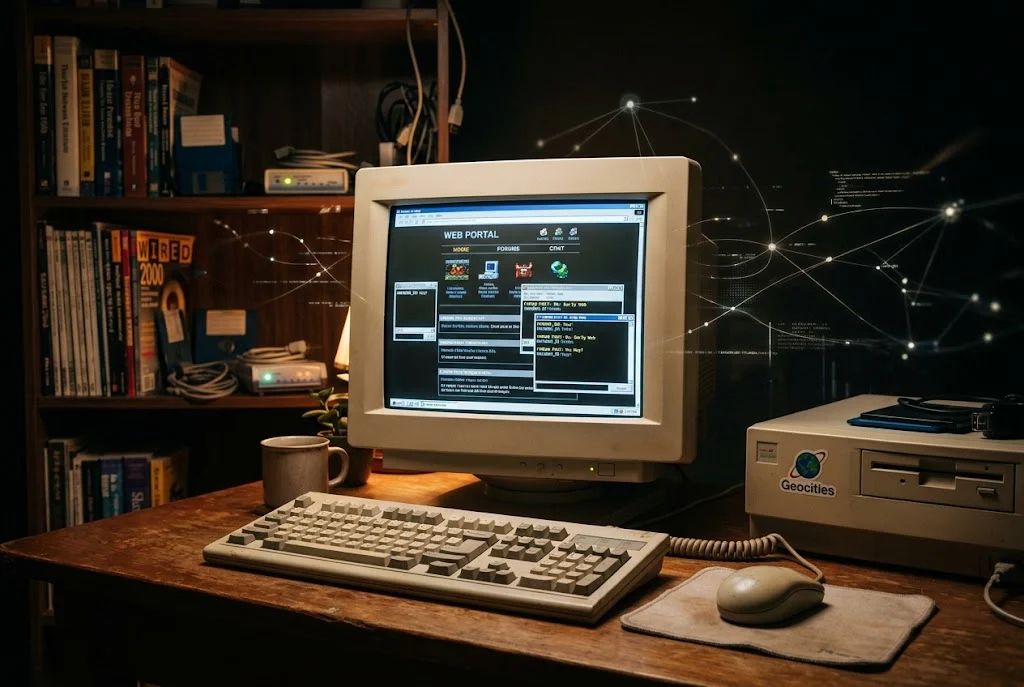
The internet has never been more powerful, connected, or convenient than it is today. People can communicate across continents instantly, discover information within seconds, and use sophisticated platforms for everything from entertainment to education. Yet alongside this technological progress, an unexpected interest in the internet of the past has started to grow.
This trend is often described as early internet nostalgia. It reflects renewed interest in old forums, chat rooms, personal websites, message boards, blogs, and the informal culture that defined the web during the late 1990s and early 2000s.
For people who experienced that period firsthand, the old internet can bring back memories of exploration and discovery. For younger users, it can represent something completely different: an online environment that feels less polished, less commercial, and less controlled by algorithms.
What Made the Early Internet Different?
The early web was much more decentralized than the internet most people use today. Instead of spending the majority of their online time inside a small number of major social networks, users moved between thousands of independent websites and communities.
People created personal homepages, joined discussion boards, published simple blogs, shared links, and participated in communities built around specific interests. Websites were often imperfect, experimental, and highly individual.
That lack of uniformity was part of the experience.
Finding something interesting often required exploration. Users followed links, searched through directories, exchanged recommendations, and discovered websites without knowing exactly what they would encounter.
The experience could be slower than today’s web, but it also contained a greater sense of unpredictability.
The Appeal of Simple Online Communities
One of the strongest reasons people remember the early internet positively is the simplicity of its communities.
Forums and message boards allowed users to gather around shared interests without necessarily building large public profiles. Someone interested in music could join a music forum, while another person could spend time discussing games, technology, photography, books, or hobbies.
Participation did not always depend on collecting followers or generating engagement.
A person could simply join a discussion, contribute an opinion, ask a question, and return whenever they wanted. The emphasis was often placed on the conversation itself rather than the performance of an online identity.
That difference feels increasingly significant in an era when social platforms can encourage users to think carefully about how they appear to other people.
Why Digital Nostalgia Is Growing Again
The renewed interest in the old web does not necessarily mean people want to abandon modern technology. Instead, it may reflect dissatisfaction with some aspects of the current digital experience.
Today’s platforms are exceptionally good at predicting what users want. Algorithms analyze behavior and use that information to recommend videos, articles, products, accounts, and conversations.
Personalization makes online experiences convenient, but it can also make them feel predictable.
The early web worked differently. Users could stumble across an unusual website, enter an unfamiliar forum, discover a strange blog, or encounter an unexpected opinion.
That sense of discovery is an important part of early internet nostalgia. People are remembering a digital environment where not everything was optimized for attention.
The Search for More Authentic Communication
Another important part of this nostalgia is the desire for more genuine interaction.
Modern online profiles often contain carefully selected photographs, descriptions, achievements, interests, and opinions. Over time, social media has made online identity increasingly visible and sometimes highly curated.
The early internet was often less concerned with presentation.
People could use usernames, avatars, simple profile pages, or anonymous accounts. Conversations could happen without requiring someone to establish a carefully constructed personal brand first.
This does not mean anonymity was always positive or that older platforms were better in every respect. However, the contrast helps explain why authentic web communication has become an increasingly interesting subject in today’s digital culture.
For a deeper look at this broader shift toward spontaneous and genuine online interaction, readers can explore our article on authentic web communication.
The Return of Spontaneous Online Conversations
The same desire for unpredictability can be seen in the renewed interest in spontaneous online conversations.
Instead of preparing a post for an existing audience, users can increasingly choose experiences based around immediate interaction. The appeal comes from not knowing exactly what will happen next.
This resembles one of the most memorable characteristics of the early web: the possibility of unexpected encounters.
A conversation could begin casually and develop into an interesting exchange with someone who had completely different experiences or interests. There was no guarantee that every interaction would become meaningful, but the uncertainty itself made the experience engaging.
Modern platforms can recreate some of that feeling while using faster connections, improved interfaces, stronger moderation, and mobile-friendly technology.
Early Internet Culture and Online Identity
The early internet also offered users different ways to experiment with identity.
A username or avatar could become a recognizable identity inside a particular community without necessarily being connected to a person’s entire offline life. People could participate in discussions based on their interests rather than their professional position or social status.
Personal websites were another example.
Instead of using standardized social profiles, people could create pages that reflected their individual personality. Designs could be unusual, colorful, unfinished, or highly creative.
That freedom contributed to the distinctive character of early internet culture.
Today’s websites are generally faster, more accessible, and easier to navigate, but the old web reminds us that individuality does not always require sophisticated design.
What Today’s Internet Can Learn From the Old Web
The renewed interest in early internet culture offers several useful lessons for modern technology platforms.
Simplicity Still Has Value
Not every online experience needs dozens of features. Sometimes a simple interface can make communication easier by removing distractions.
Discovery Matters
Algorithms can make finding content incredibly efficient, but unexpected discovery can also make the internet more exciting. Users benefit when digital environments leave some room for exploration.
Communities Can Be More Important Than Popularity
Small communities built around shared interests can create meaningful interactions without requiring millions of followers.
Not Every Interaction Needs to Be Permanent
Temporary conversations can have value. People may sometimes prefer an interaction that exists for a moment rather than becoming another permanent part of their digital history.
These principles are particularly relevant to the latest technology trends shaping the modern web, where developers increasingly have to balance convenience, personalization, privacy, and human connection.
A New Version of the Old Internet
The internet is unlikely to return literally to the early 2000s.
Users now expect fast connections, reliable video, strong security, mobile compatibility, and convenient services. Those expectations are not going away.
Instead, the future may combine modern infrastructure with some of the characteristics people associate with the old web.
That could include smaller communities, independent publishing, spontaneous conversations, niche interest groups, and digital spaces that prioritize interaction rather than constant engagement.
In this sense, early internet nostalgia is not simply about remembering old technology. It is about reconsidering the qualities that made people enjoy being online in the first place.
Why the Old Web Still Matters
The continued fascination with the early internet demonstrates that technological progress does not automatically make every aspect of the online experience better.
Faster connections and smarter algorithms have solved many problems, but they have also changed how people discover information, communicate, and present themselves.
The old web represents a different philosophy of being online. It was more fragmented, less polished, and sometimes frustrating, but it also encouraged curiosity and experimentation.
That combination explains why its influence continues to appear in modern digital culture.
Conclusion
People are rediscovering the early internet because it represents more than outdated technology. It reminds users of a period when the web felt exploratory, personal, unpredictable, and less dominated by carefully optimized digital experiences.
The answer may not be to recreate the internet of the past. Instead, the future could take the best elements of both eras: modern speed and security combined with greater simplicity, discovery, individuality, and spontaneous human interaction.
As digital culture continues to evolve, the lessons of the old web may become increasingly relevant. Sometimes moving forward also means remembering what made the journey enjoyable in the first place.