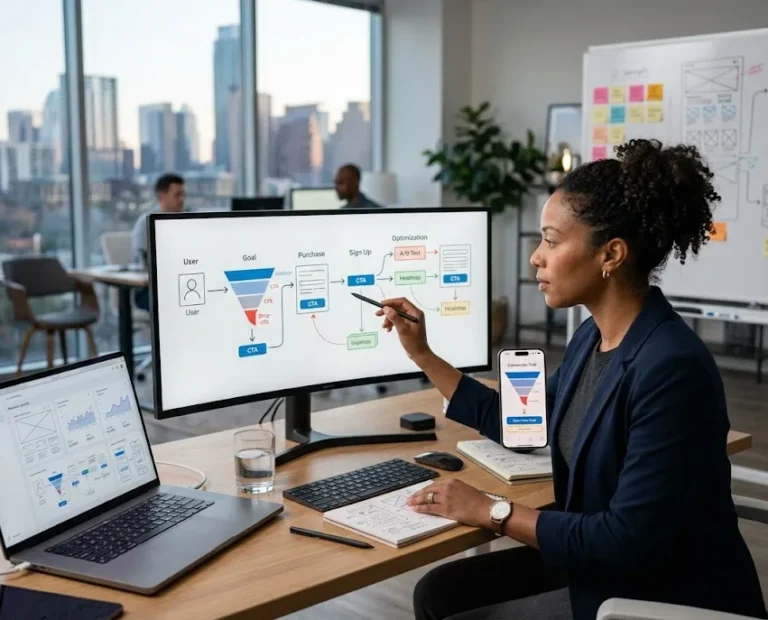
The latest technology trends in 2026 are moving beyond experimentation and into practical use across businesses, industries, and everyday life. Artificial intelligence remains a major force, but the technology landscape is becoming broader as AI agents, robotics, AI infrastructure, cybersecurity, quantum computing, and intelligent connected systems continue to develop.
For businesses and technology professionals, understanding these changes is increasingly important. Some technologies are already producing measurable value, while others remain early-stage innovations that require careful evaluation. The key is not to adopt every new technology simply because it is receiving attention. Instead, organizations should understand where emerging tech can solve real problems and where the risks or costs may outweigh the benefits.
This guide explores the major technology trends worth watching in 2026 and explains why they matter for businesses, professionals, startups, and consumers.
Why the Latest Technology Trends Matter in 2026
Technology is developing at a pace that makes traditional planning more difficult. Artificial intelligence is increasingly being integrated into software, business operations, cybersecurity, infrastructure, and physical machines.
McKinsey’s 2026 technology research found that AI has become the leading technology investment priority among surveyed organizations, with companies increasingly focusing on agentic AI and data as part of their operating models. This reflects a broader shift from experimenting with AI toward finding ways to integrate it into real business processes.
At the same time, the World Economic Forum’s 2026 emerging technology research highlights technologies ranging from quantum cryptography and advanced biotechnology to new energy applications and other innovations that could move from development into wider commercial use.
These developments suggest that the future technology landscape will not be defined by one invention. Instead, multiple technologies will increasingly work together.
1. Agentic AI Is Moving Beyond Basic Chatbots
One of the most important latest technology trends is the rise of agentic AI. Traditional generative AI typically responds to prompts by producing text, images, code, or other content. AI agents are designed to go further by planning tasks, using tools, making decisions, and completing multi-step workflows with varying degrees of human supervision.
This shift could change how organizations use software. Instead of employees manually moving information between different applications, an AI agent may eventually coordinate several steps within a workflow.
Examples could include:
- Automating repetitive administrative workflows
- Researching and organizing information
- Supporting customer service operations
- Assisting software development
- Monitoring business processes
- Preparing reports and summaries
- Coordinating tasks across enterprise software
IBM’s 2026 technology roadmap describes the movement from standalone AI models toward multi-agent systems that can plan, act, and adapt in real time. However, organizations still need strong controls because autonomous systems can introduce new security and reliability challenges.
This trend also connects directly with the growing role of tech innovations in modern business operations.
2. Physical AI and Smarter Robotics
AI is increasingly moving from screens and software into the physical world. Robots, autonomous machines, intelligent vehicles, drones, and other systems can combine sensors, computing, machine learning, and physical movement to perform tasks in real environments.
Forrester’s 2026 emerging technology research identifies physical AI as an important development as artificial intelligence begins to influence robots, vehicles, and other physical environments.
Potential applications include manufacturing, logistics, healthcare, agriculture, transportation, warehousing, and industrial inspection.
The development of physical AI is particularly significant because software-based automation and physical automation can increasingly complement each other. A warehouse, for example, could combine AI-powered planning software with intelligent machines that physically move goods.
3. AI Infrastructure and the Race for Computing Power
As AI systems become more capable, the infrastructure supporting them becomes increasingly important. Training and running advanced AI models requires substantial computing resources, storage, networking, cooling, and energy.
This is creating greater attention around specialized processors, AI accelerators, data centers, inference infrastructure, cloud computing, and efficient computing architectures.
Deloitte’s 2026 technology research identifies the economics of AI infrastructure as a major trend, while McKinsey highlights infrastructure as a critical foundation for scaling agentic AI.
For businesses, this means AI strategy cannot be separated completely from infrastructure strategy. Organizations need to consider where models will run, how data will be accessed, how much computing is required, and how costs will be managed.
4. AI-Native Software Development
Software development is another area undergoing significant change. AI coding assistants can already help developers generate code, explain existing systems, identify errors, write tests, and perform other development tasks.
The next stage is broader AI-native development, where AI becomes integrated throughout the software development lifecycle rather than being used only as an occasional coding assistant.
Developers may increasingly work with AI systems that assist with:
- Requirements analysis
- Code generation
- Testing
- Debugging
- Documentation
- Code review
- Application modernization
- Software maintenance
This does not necessarily eliminate the need for developers. Instead, it can change how developers spend their time, potentially shifting more attention toward architecture, product decisions, quality assurance, security, and problem-solving.
5. Cybersecurity Is Becoming More AI-Driven
As AI becomes more powerful, cybersecurity becomes even more important. Attackers can use automation and AI to discover vulnerabilities, generate convincing phishing material, analyze information, and accelerate certain types of attacks.
Defenders are responding by using AI to identify suspicious activity, analyze large volumes of security information, automate investigations, and respond to threats more quickly.
McKinsey’s 2026 research notes that the adoption of agentic AI is expanding the potential attack surface because autonomous systems can access data, applications, and other resources on behalf of organizations.
This means businesses need to think beyond traditional cybersecurity controls. Identity management, access permissions, monitoring, governance, data protection, and oversight of nonhuman systems are becoming increasingly important.
For organizations exploring smart technologies, security should be considered from the beginning rather than added after implementation.
6. AI Security and Responsible AI Become Business Priorities
AI adoption creates opportunities, but it also creates concerns around inaccurate outputs, privacy, cybersecurity, data exposure, bias, governance, and uncontrolled automation.
McKinsey’s 2026 research on AI trust found that security and risk concerns remain a major barrier to scaling agentic AI. This suggests that organizations are increasingly concerned not only with whether AI works, but also with whether it can be deployed safely and reliably.
Responsible AI practices can include:
- Defining clear AI usage policies
- Controlling access to sensitive information
- Testing AI systems before deployment
- Monitoring outputs and automated actions
- Maintaining appropriate human oversight
- Documenting important AI decisions
- Reviewing third-party AI tools carefully
As AI becomes integrated into business operations, trust and governance can become competitive advantages rather than purely technical concerns.
7. Quantum Computing Continues Its Long-Term Rise
Quantum computing remains an emerging technology, but 2026 is bringing greater attention to potential commercial applications. Quantum computers use fundamentally different approaches to computation and could eventually help address certain complex problems that are difficult for conventional systems.
Potential areas of interest include optimization, materials science, chemistry, financial modeling, drug discovery, and cryptography.
However, quantum computing should not be treated as a replacement for conventional computing in everyday applications. The technology is still developing, and practical commercial use depends on advances in hardware, error correction, software, and scalability.
Businesses are nevertheless beginning to investigate quantum readiness. Recent reporting indicates that enterprise investment in quantum computing is increasing as organizations explore potential use cases and prepare for future applications.
The World Economic Forum also includes quantum-related technologies among its 2026 emerging technology areas, showing that quantum development remains part of the broader future technology conversation.
8. Post-Quantum Cybersecurity Is Becoming More Important
The development of quantum computing creates another technology priority: preparing existing security systems for a future in which sufficiently capable quantum computers could threaten some current cryptographic approaches.
Post-quantum cryptography focuses on cryptographic methods designed to remain secure against quantum computing threats.
Organizations with sensitive information that must remain protected for many years have a reason to consider this issue now. Migration can take significant time because businesses need to identify where cryptography is being used, understand dependencies, assess systems, and coordinate with technology providers.
This is an example of how two seemingly separate emerging tech developments can influence each other. Progress in quantum computing can affect cybersecurity planning long before quantum computers become commonplace.
9. Domain-Specific AI Models
General-purpose AI models receive much of the public attention, but organizations are increasingly interested in systems designed for specific industries or business functions.
Domain-specific models can be trained, configured, or adapted around specialized terminology, workflows, regulations, datasets, and professional requirements.
For example, organizations may want AI systems optimized for areas such as finance, healthcare, legal services, engineering, manufacturing, customer support, or scientific research.
The advantage of specialization can be better alignment with the context in which the system is being used. However, organizations still need to evaluate accuracy, data quality, security, cost, and governance.
10. Edge AI and Intelligent Devices
Another technology trend worth watching is the movement of AI capabilities closer to the devices where data is generated. Instead of sending every piece of information to a remote cloud service, some AI processing can happen directly on devices or at the network edge.
This can be useful for applications that require quick responses, limited connectivity, privacy, or reduced dependence on centralized infrastructure.
Potential applications include:
- Smart cameras
- Industrial sensors
- Connected vehicles
- Wearable devices
- Retail systems
- Industrial equipment
- Smart home devices
Edge AI can complement cloud infrastructure rather than necessarily replacing it. Many future systems may use a combination of local and cloud-based processing depending on the workload.
11. Intelligent Connectivity and Connected Systems
Connected devices are becoming more useful as sensors, AI, cloud platforms, and communication networks work together.
The next generation of connected systems is less about simply putting devices online and more about enabling those devices to collect information, understand conditions, communicate with other systems, and support automated decisions.
Smart manufacturing is one example. Sensors can monitor equipment while AI systems analyze information and identify patterns that could indicate maintenance needs.
Similar concepts can apply to transportation, energy, logistics, agriculture, healthcare, and buildings.
12. AI-Powered Scientific and Healthcare Innovation
AI is also influencing scientific research and healthcare by helping researchers process large datasets, identify patterns, generate hypotheses, and accelerate parts of the discovery process.
The World Economic Forum’s 2026 emerging technologies report highlights developments including advanced biotechnology and personalized approaches to medicine.
AI can support scientific work, but the technology does not remove the need for rigorous validation. Research findings, medical applications, and biological discoveries require appropriate testing, expert review, safety evaluation, and regulatory oversight.
13. Energy-Efficient Technology and Computing
The growing demand for AI computing is also increasing attention on energy efficiency. Data centers and AI infrastructure require substantial electricity, making efficient computing, cooling, power management, and energy sourcing increasingly important technology considerations.
This creates an interesting connection between computing and energy technology. More powerful AI systems require more infrastructure, while more efficient hardware and better data-center designs can help reduce the resources required for individual workloads.
Future technology development will therefore increasingly involve not only making systems more powerful, but also making them more efficient.
14. Multiagent Systems and AI Collaboration
AI agents do not necessarily have to operate individually. Multiagent systems allow different AI agents to specialize in different tasks and coordinate their work.
One agent could gather information, another could analyze it, and another could prepare an output or initiate a workflow. This approach could eventually support more complex business processes.
Gartner’s 2026 strategic technology trends include multiagent systems among its highlighted developments, while IBM’s technology roadmap also points toward multi-agent architectures as part of the evolution of AI software.
However, coordination introduces additional challenges. Organizations need to control permissions, monitor actions, manage errors, and understand how multiple agents interact with one another.
15. Digital Provenance and Trustworthy Information
As AI-generated content becomes easier to create, knowing where digital information came from can become increasingly valuable.
Digital provenance involves tracking the origin, history, or authenticity of digital content and information. This can matter for journalism, business documents, software, creative content, scientific information, and other areas where trust is important.
Technology that helps establish where information originated and whether it has been modified can become more important as synthetic media and automated content generation continue to grow.
What These Technology Trends Mean for Businesses
The biggest lesson from the latest technology trends is that organizations should focus on business problems rather than technology hype.
A company does not need to adopt every emerging technology. Instead, decision-makers should ask:
- What business problem are we trying to solve?
- Can technology improve the process meaningfully?
- What data and infrastructure would be required?
- What skills would employees need?
- What security and privacy risks could arise?
- How will success be measured?
- Can the technology scale economically?
This approach is particularly important for smaller organizations and startups with limited resources. The best technology investment is not always the newest technology. It is the technology that creates meaningful value relative to its cost and risk.
How Startups Can Respond to Emerging Technology
Startups can sometimes benefit from emerging technology because they are able to experiment without the legacy systems that larger organizations may have to maintain.
However, startups should still avoid adopting technology simply because it is popular. AI, automation, cloud platforms, analytics, and other technologies should be connected to a clear customer or operational problem.
Companies exploring new technology can also monitor our upcoming guide to startup trends for a broader look at the business environment influencing new ventures in 2026.
How Professionals Can Prepare for Future Technology
Technology trends also affect individual careers. Professionals do not necessarily need to become technology specialists, but developing digital literacy and understanding how new tools affect their industries can improve adaptability.
Useful capabilities can include:
- AI literacy
- Data interpretation
- Digital collaboration
- Cybersecurity awareness
- Problem-solving
- Critical thinking
- Adaptability
- Technology-assisted productivity
Continuous professional development can help workers remain prepared as technology changes the skills employers need.
How to Separate Technology Hype From Real Innovation
Not every technology receiving attention in 2026 will become a mainstream success. Some innovations will mature quickly, while others may remain niche or fail to deliver expected benefits.
When evaluating a new technology, look for evidence of real-world adoption, measurable outcomes, credible technical progress, practical use cases, security considerations, and a sustainable economic model.
It is also useful to distinguish between a technology that is technically possible and one that is commercially ready. A promising laboratory result may still require years of development before businesses can deploy it at scale.
The Future Technology Landscape
The future technology landscape is likely to be defined by convergence. AI will increasingly connect with robotics, cloud infrastructure, cybersecurity, edge computing, scientific research, and connected devices.
Instead of viewing each technology as an isolated trend, businesses should consider how multiple technologies can work together. AI agents may depend on specialized models, cloud infrastructure, secure data, identity systems, and reliable connectivity. Physical AI may depend on robotics, sensors, edge computing, and advanced AI models.
This convergence is one reason technology strategy is becoming increasingly important at the business level.
Final Thoughts on the Latest Technology Trends
The latest technology trends in 2026 show a clear movement toward more capable, connected, autonomous, and intelligent systems. Agentic AI, physical AI, AI infrastructure, cybersecurity, quantum computing, edge AI, domain-specific models, and intelligent connected systems are all worth watching as the technology landscape continues to evolve.
Some of these technologies are already creating practical value, while others remain longer-term opportunities. The most effective approach is to evaluate each development based on its real capabilities, business relevance, cost, security implications, and maturity.
For businesses, professionals, and technology leaders, staying informed is only the first step. The real advantage comes from understanding which innovations are relevant to your goals and knowing when the technology is mature enough to justify investment.
As 2026 progresses, the most important technology story may not be the arrival of one revolutionary invention. It may be the growing convergence of AI, software, hardware, data, infrastructure, and intelligent machines into systems that can increasingly understand, decide, and act.