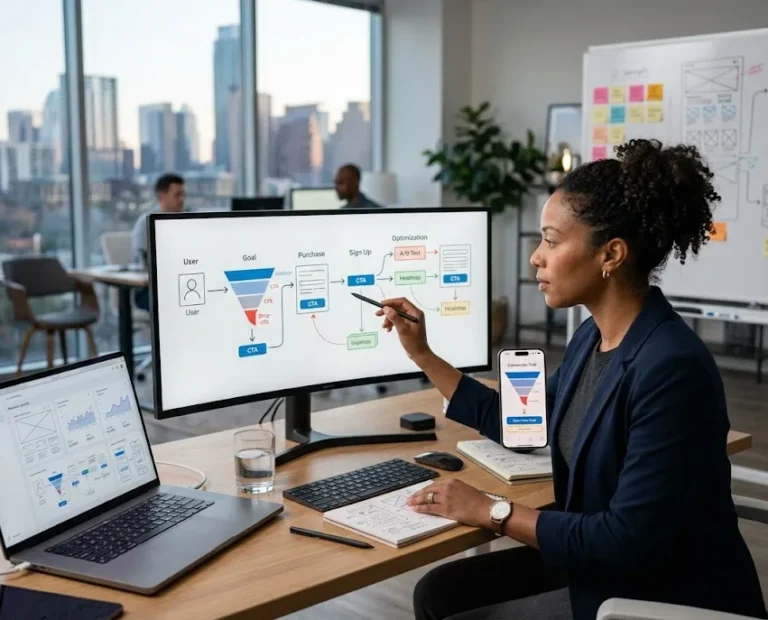
Tech innovations are changing how businesses operate, compete, serve customers, and make decisions in 2026. Artificial intelligence, automation, cloud computing, connected devices, advanced analytics, cybersecurity, and intelligent software are moving from experimental concepts into practical business applications.
For companies of all sizes, technology is no longer simply an IT concern. New digital capabilities can influence customer experiences, employee productivity, supply chains, marketing, product development, financial management, and strategic decision-making. However, successful adoption requires more than buying new software. Businesses need to understand which innovations solve genuine problems and how those technologies fit into their existing operations.
This guide explores the major business technologies shaping 2026 and explains how organizations can evaluate and apply them strategically.
What Are Tech Innovations?
Tech innovations are new or significantly improved technologies, tools, systems, or methods that can change how organizations or individuals perform tasks and solve problems. Some innovations introduce entirely new capabilities, while others make existing processes faster, cheaper, safer, or more efficient.
In business, innovation can involve software, hardware, data systems, artificial intelligence, communication networks, automation, cybersecurity, robotics, or new ways of combining existing technologies.
The important distinction is that innovation is not simply about using the newest product. A technology becomes strategically valuable when it solves a meaningful problem or creates an opportunity that was previously difficult to achieve.
Why Tech Innovations Matter to Businesses
Businesses operate in environments where customer expectations, competition, costs, regulations, and technology can change quickly. Technology can help organizations respond to these changes more effectively.
Business technology can support organizations by helping them:
- Automate repetitive processes
- Improve customer experiences
- Analyze large amounts of information
- Reduce operational friction
- Improve collaboration
- Develop new products and services
- Strengthen cybersecurity
- Make faster data-informed decisions
- Scale operations more efficiently
However, technology adoption should begin with a business objective. The most advanced system is not necessarily the most useful one for a particular organization.
1. Artificial Intelligence Is Becoming a Business Operating Layer
Artificial intelligence is one of the most influential business technology developments of 2026. Companies are increasingly using AI for content creation, research, customer service, software development, analytics, internal knowledge management, and workflow automation.
The next phase is moving beyond isolated AI tools toward broader integration across business processes. Instead of using AI only to generate a response, companies can increasingly connect AI systems to organizational data, software platforms, and workflows.
Possible applications include:
- Automating repetitive administrative tasks
- Summarizing business information
- Supporting customer service teams
- Analyzing documents
- Assisting employees with internal knowledge
- Generating software code
- Supporting business research
- Identifying patterns in operational data
Businesses should still maintain appropriate human oversight, particularly when AI systems influence important decisions or interact with sensitive information.
2. Agentic AI Is Changing Workflow Automation
Traditional automation generally follows predefined rules. Agentic AI introduces systems capable of handling more complex sequences of tasks, using tools, interpreting information, and adjusting actions according to a defined objective.
For example, an AI agent could potentially receive a business request, research relevant information, organize the findings, update a system, and prepare a report rather than requiring a person to manually complete every individual step.
This development could make automation more flexible, but it also introduces new governance challenges. Businesses need to determine what agents can access, which actions require approval, how activity is monitored, and what happens when an agent makes a mistake.
Organizations interested in the broader technology landscape can also explore our guide to latest technology trends for additional context on emerging developments in 2026.
3. Smart Technologies Are Connecting Physical and Digital Operations
Smart technologies combine sensors, software, connectivity, analytics, and automation to make physical systems more intelligent.
Businesses can use connected systems to monitor equipment, track inventory, analyze environmental conditions, manage facilities, or improve logistics.
For example, a manufacturing facility can use sensors to collect information from machinery and software to identify unusual patterns. A logistics company can combine connected tracking systems with analytics to improve visibility across shipments.
These applications show why smart technologies are becoming an important part of digital transformation. They allow organizations to connect real-world activity with digital decision-making.
4. Cloud Computing Is Becoming More Intelligent
Cloud computing has already transformed how businesses access software and infrastructure. The next stage involves integrating cloud environments with AI, automation, advanced analytics, and increasingly specialized computing resources.
Cloud platforms can provide businesses with flexible access to computing resources without requiring every organization to build and maintain all infrastructure internally.
For growing businesses, this flexibility can be particularly useful because infrastructure can often be adjusted as requirements change.
However, cloud adoption still requires careful planning around security, costs, data governance, application architecture, and vendor dependencies.
5. AI Infrastructure Is Becoming a Strategic Investment
As businesses use more AI, they need infrastructure capable of supporting increasingly demanding workloads. This includes computing hardware, data storage, networking, specialized processors, cooling, and energy management.
The growth of AI infrastructure is creating opportunities for companies involved in chips, data centers, cloud services, networking, and energy-efficient computing.
For businesses deploying AI, infrastructure decisions can influence cost, performance, scalability, security, and reliability. Organizations therefore need to evaluate infrastructure as part of their overall AI strategy rather than treating it as an isolated technical concern.
6. Automation Is Expanding Beyond Repetitive Tasks
Business automation has traditionally focused on repetitive, rule-based activities. Advances in AI and software integration are allowing automation to expand into more flexible workflows.
Businesses can automate activities such as:
- Data entry
- Document processing
- Appointment scheduling
- Customer communication
- Report preparation
- Invoice processing
- Internal notifications
- Workflow routing
Automation can free employees from repetitive work, but organizations should redesign processes carefully. Automating a poorly designed process does not necessarily make the overall operation better.
7. Cybersecurity Is Becoming More Intelligent
As businesses become increasingly digital, cybersecurity becomes an essential part of technology strategy. Organizations are using AI, automation, identity systems, monitoring tools, and analytics to identify and respond to threats.
At the same time, attackers can also use automation and AI to create more sophisticated threats. This creates a technology race between defensive and offensive capabilities.
Businesses should therefore consider cybersecurity from the beginning of technology projects. Security should not be treated as something that can simply be added after deployment.
8. Zero Trust Security Is Influencing Business IT
Traditional security models often assumed that users or devices inside an organization’s network could be trusted more than external systems. Modern distributed workplaces make this assumption increasingly difficult.
Zero trust approaches emphasize verifying users, devices, applications, and access requests rather than automatically trusting them based on network location.
This can become especially important as employees work remotely, use cloud applications, and access company resources from multiple devices and locations.
9. Data Analytics Is Becoming More Accessible
Data has long been valuable to businesses, but advanced analytics tools are becoming easier for non-specialists to use. Natural-language interfaces and AI-assisted analytics can help employees ask questions about business information without always requiring advanced technical skills.
Organizations can use analytics to understand customer behavior, sales performance, operational efficiency, marketing results, inventory, financial patterns, and other business indicators.
The quality of the underlying data still matters. AI-powered analytics cannot compensate for incomplete, inaccurate, outdated, or poorly structured information.
10. Digital Twins Are Expanding Business Visibility
A digital twin is a digital representation of a physical object, system, or process that can be used to monitor, analyze, or simulate real-world conditions.
Businesses can use digital twin concepts in manufacturing, construction, transportation, energy, facilities, and other industries.
For example, a company could create a digital representation of equipment and use real-world sensor information to understand performance and identify potential problems.
The value of digital twins comes from connecting data with decision-making. The technology can help organizations evaluate scenarios without necessarily experimenting directly on physical systems.
11. Robotics and Physical AI Are Entering More Workplaces
Robotics is another area where software and physical technology are increasingly converging. Modern robots can combine sensors, machine learning, computer vision, and advanced control systems.
Potential business applications include manufacturing, warehousing, logistics, agriculture, healthcare, inspection, and other environments where physical tasks can be structured or assisted by intelligent machines.
Physical AI could eventually enable robots to operate in less predictable environments than traditional industrial automation, although reliability, safety, cost, and deployment complexity remain important considerations.
12. Edge Computing Brings Processing Closer to Users
Edge computing moves some processing closer to the devices and locations where data is generated. This can reduce latency and support applications where immediate responses are important.
Edge systems can be useful for industrial equipment, connected vehicles, smart cameras, retail systems, healthcare devices, and other environments where sending every piece of information to a distant data center may not be ideal.
Edge and cloud computing are not necessarily competing approaches. Businesses can combine them according to the needs of each application.
13. Business Technology Is Becoming More Connected
Modern organizations often use dozens of software systems for communication, finance, marketing, sales, customer management, human resources, operations, and project management.
Connecting these systems can reduce duplicate data entry and improve information flow. APIs, integration platforms, automation tools, and cloud services make it easier for businesses to connect different applications.
However, integration should be planned carefully. Poorly connected systems can create data inconsistencies, security risks, and maintenance problems.
14. AI-Powered Customer Experiences
Customer expectations are changing as people become accustomed to instant digital interactions. Businesses are using AI to provide faster customer support, personalized recommendations, intelligent search, and automated assistance.
AI can help organizations handle routine questions while allowing human employees to focus on complex cases that require judgment or empathy.
The best customer experience strategies do not necessarily remove humans from the process. Instead, they use technology to make human support more efficient and accessible when it matters most.
15. Personalization Is Becoming More Data-Driven
Businesses increasingly want to provide customers with relevant information rather than showing identical experiences to everyone.
Data and AI can help personalize product recommendations, content, marketing messages, search results, and customer interactions.
However, personalization creates privacy responsibilities. Businesses need to understand what data they collect, why they collect it, how it is used, and what controls customers have.
16. Technology Is Changing Product Development
AI-assisted design, rapid prototyping, analytics, simulation, and collaborative software can help companies develop products more quickly and test ideas before making larger investments.
Technology can support multiple stages of product development, including research, design, testing, documentation, and customer feedback analysis.
Organizations can therefore use innovation not only to improve existing products but also to shorten the process of developing new ones.
17. Digital Innovation Is Reshaping Small Businesses
Digital innovation is not limited to large corporations. Small businesses can increasingly access cloud software, AI tools, analytics platforms, automation systems, ecommerce technologies, and digital marketing services without building everything internally.
This can reduce some barriers to adopting sophisticated business technology.
Small businesses should nevertheless prioritize carefully. A company may gain more value from automating one important administrative process than from purchasing several advanced tools that employees rarely use.
18. Technology Is Creating New Startup Opportunities
Emerging technologies can also create opportunities for startups. Entrepreneurs can build products around AI, automation, cybersecurity, specialized software, data services, robotics, and other growing areas.
The strongest opportunities generally emerge where technology solves a specific customer problem rather than where entrepreneurs simply add a fashionable technology to an existing concept.
For a broader look at this changing environment, see our upcoming guide to startup trends.
19. SaaS Is Becoming More Intelligent
Software as a service continues to be an important business technology model. However, SaaS products are increasingly incorporating AI-powered features, automation, analytics, personalization, and natural-language interfaces.
This can make business software more accessible because employees may be able to interact with complex systems using simpler interfaces.
Organizations evaluating SaaS products should still consider security, integrations, data ownership, pricing, scalability, support, and vendor reliability.
20. Technology and Employee Productivity
One of the most practical areas of business innovation is employee productivity. AI assistants, collaboration platforms, workflow automation, knowledge systems, and intelligent search can reduce the time employees spend looking for information or completing repetitive tasks.
However, productivity should not be measured simply by the number of tasks automated. Businesses should determine whether technology improves meaningful outcomes such as quality, speed, customer satisfaction, employee capacity, or operational efficiency.
How Businesses Should Evaluate New Technology
Not every technology trend deserves immediate investment. Before adopting a new system, businesses should evaluate its relevance, maturity, cost, security, scalability, and measurable benefits.
A practical evaluation can include these questions:
- What problem does the technology solve?
- Who will use it?
- What measurable outcome should improve?
- What data will it require?
- How will it integrate with existing systems?
- What security and privacy risks exist?
- What will implementation and ongoing operation cost?
- How difficult will it be for employees to adopt?
- What happens if the technology fails?
- Can the solution scale as the business grows?
These questions can help organizations distinguish useful innovation from technology hype.
How Employees Can Adapt to Business Technology Changes
Technology adoption also changes the skills employees need. Professionals do not necessarily need to become programmers or technology specialists, but digital literacy is becoming increasingly valuable across many occupations.
Useful capabilities include AI literacy, data interpretation, communication, critical thinking, problem-solving, cybersecurity awareness, and adaptability.
Employees can strengthen their position by learning how technology affects their particular industry and by understanding how new tools can improve their existing work.
The Connection Between Technology and Business Strategy
Technology works best when it supports a clear business strategy. Organizations should not create technology projects simply because competitors are using a particular tool.
Instead, technology decisions should connect with goals such as improving customer experience, reducing costs, increasing efficiency, entering new markets, developing products, strengthening security, or creating new revenue opportunities.
This strategic approach also helps companies decide when not to adopt a technology. Sometimes the most responsible decision is to wait until a solution becomes more mature.
What Businesses Can Expect Next
The next stage of business technology will likely involve greater convergence between AI, software, data, infrastructure, cybersecurity, robotics, and connected devices.
AI agents may increasingly interact with business applications. Physical machines may become more intelligent. Analytics may become easier for employees to use. Cybersecurity systems may become more automated. Cloud and edge infrastructure may work together to support increasingly intelligent applications.
These developments will not affect every business in exactly the same way. Industry, company size, regulatory requirements, customer expectations, and available resources will influence which technologies provide the greatest value.
Final Thoughts on Tech Innovations
Tech innovations are reshaping modern businesses by changing how organizations automate work, understand information, serve customers, develop products, protect systems, and create new opportunities.
Artificial intelligence is an important part of this transformation, but it is only one piece of the larger picture. Smart technologies, cloud computing, cybersecurity, robotics, analytics, edge computing, connected systems, and digital innovation are also influencing the way companies operate.
The businesses most likely to benefit from these developments will not necessarily be those that adopt the greatest number of technologies. They will be the organizations that identify meaningful problems, select appropriate solutions, manage risks carefully, and help employees use technology effectively.
Innovation is ultimately valuable when it produces better outcomes. As technology continues to evolve through 2026 and beyond, businesses should remain curious about new possibilities while staying disciplined about where and when they invest.